



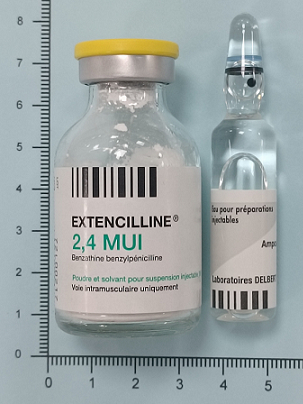

Benzathine benzylpenicillin
Dose and duration of treatment
Standard treatment:
Adults and adolescents: 1.2 MIU once a week.
Children > 30 kg of body weight: 1.2 MIU once a week.
Children < 30 kg of body weight: 600,000 MIU once a week. Duration of treatment: single dose.
Treatment of syphilis:
Primary and secondary stage
Adults and adolescents: 1 x 2.4 MIU.
Children: 50,000 IU/kg of body weight, without however exceeding 2.4 MIU.
(The treatment should be repeated if clinical symptoms reappear or if the laboratory results remain
strongly positive).
Duration of treatment: single dose.
Late-stage syphilis (latent seropositive syphilis)
Adults and adolescents: 2.4 MIU once a week.
Children: 50,000 IU/kg of body weight without however exceeding 2.4 MIU.
Duration of treatment: 3 weeks.
Treatment of congenital syphilis: without neurological involvement
Neonates and infants: 1 x 50,000 IU/kg of body weight. Duration of treatment: single dose.
Treatment of yaws and pinta:
Adults and adolescents: 1 x 1.2 MIU.
Children > 30 kg of body weight: 1 x 1.2 MIU.
Children < 30 kg of body weight: 1 x 600,000 IU.
Duration of treatment: single dose.
Prophylactic treatment of acute articular rheumatism, post-streptococcal glomerulonephritis and erysipelas:
Adults and adolescents: 1 x 1.2 MIU every 3 to 4 weeks. Children > 30 kg of body weight: 1 x 1.2 MIU every 3 to 4 weeks.
Children < 30 kg of body weight: 1 x 600,000 IU every 3 to 4 weeks. Duration of treatment:
a) without cardiac involvement: at least 5 years or until the age of 21 (whichever is longer),
c) persistent cardiac involvement: at least 10 years or until the age of 40 (whichever is longer); lifelong prophylactic treatment is sometimes necessary.
Following injection by the deep IM route, benzathine benzylpenicillin is absorbed very slowly releasing benzylpenicillin.
The serum peak is obtained 12 to 24 h after injection. The long plasma half-life ensures stable, prolonged penicillinaemia.
On day 14 after IM injection of 2,400,000 IU, the serum level is 0.12 µg/ml. On day 21 after injection of 1,200,000 IU, 89.0 to 97.4% of subjects have a penicillinaemia of 0.06 µg/ml (it should be remembered that 1 IU = 0.6 µg).
Humoral diffusion is good, but tissue diffusion is poor. Plasma protein binding is 40 to 60%.
Biotransformation
Biotransformation is low.
Elimination
It is mainly excreted in the urine.
Based on the general principle of refraining from combining bactericidal and bacteriostatic antibiotics, EXTENCILLINE must not be combined with bacteriostatic antibiotics.
Caution is required when co-administering the following medicinal products:
Probenecid: administration of probenecid inhibits the tubular secretion of benzylpenicillin, resulting in an increase in serum concentration and a prolongation of the elimination half-life. Probenecid also inhibits the transport of penicillin from cerebrospinal fluid, and consequently concomitant administration of probenecid further reduces the penetration of benzylpenicillin into brain tissue.
Methotrexate:
excretion of methotrexate is reduced when administered with benzathine benzylpenicillin. This may result in an increase in the toxic effects of methotrexate. Combination with methotrexate is not recommended.
Anticoagulants:
concomitant use with oral anticoagulants may increase the effect of anti-vitamin K agents and the risk of bleeding. It is recommended that the International Normalized Ratio (INR) be monitored regularly, and that the dosage of anti-vitamin K drugs be adjusted accordingly, during and after treatment with EXTENCILLINE.
